
Quick Answer: For a study room in India, use cool white or daylight LEDs between 4000K–6500K — they keep you alert and reduce eye fatigue. For ambient ceiling light, a 15W–20W LED batten or panel is ideal for a standard room. For your desk, a 7W–9W flicker-free LED bulb provides focused task lighting without glare
Product Innovation
Quick Answer: For living rooms, choose brushed brass or glossy gold — it catches ambient light beautifully. For bedrooms, go with rose gold or satin for a softer, calmer feel. In kitchens and bathrooms, matte or champagne gold resists smudges and suits reflective surfaces best. Gone are the days when electrical fittings were just functional
Quick Answer: A modular electronic fan regulator is better than an ordinary resistive regulator for Indian homes. It saves electricity by adjusting actual voltage to the fan, prevents humming, and fits neatly into modern switchboards — unlike old resistive regulators that waste power as heat even at low fan speeds. Ceiling fans are arguably the
Quick Answer: Use a 10A MCB for lighting and fans, a 16A MCB for kitchen and bathroom sockets (microwave, washing machine, fridge), and a 32A MCB for heavy appliances like air conditioners and geysers. Matching the correct MCB rating to the circuit load prevents overheating, constant tripping, and electrical fires. Every modern electrical setup requires
Quick Answer: The 5 biggest electrical mistakes during home renovation in India are: skipping the furniture layout before wiring, installing too few socket points, using undersized wires for heavy appliances, ignoring earthing, and reusing old degraded wiring. Always use ISI-certified pure copper FR wires and MCB-protected circuits before sealing your walls. Taking on a major
When designing a hospitality space, the electrical infrastructure goes far beyond standard residential wiring. Selecting the right modular switches for hotels in India is a delicate balance of robust functionality, energy management, and premium aesthetics. Unlike a private home where users are familiar with the layout, a hotel room must be intuitive, globally accommodating, and
Quick Answer: For a solar setup, you need two separate MCBs — a DC MCB between the solar panels and inverter, and a standard AC MCB between the inverter and your home wiring. For most Indian homes, a 16A DC MCB and a 32A AC MCB is the recommended combination. As renewable energy becomes more
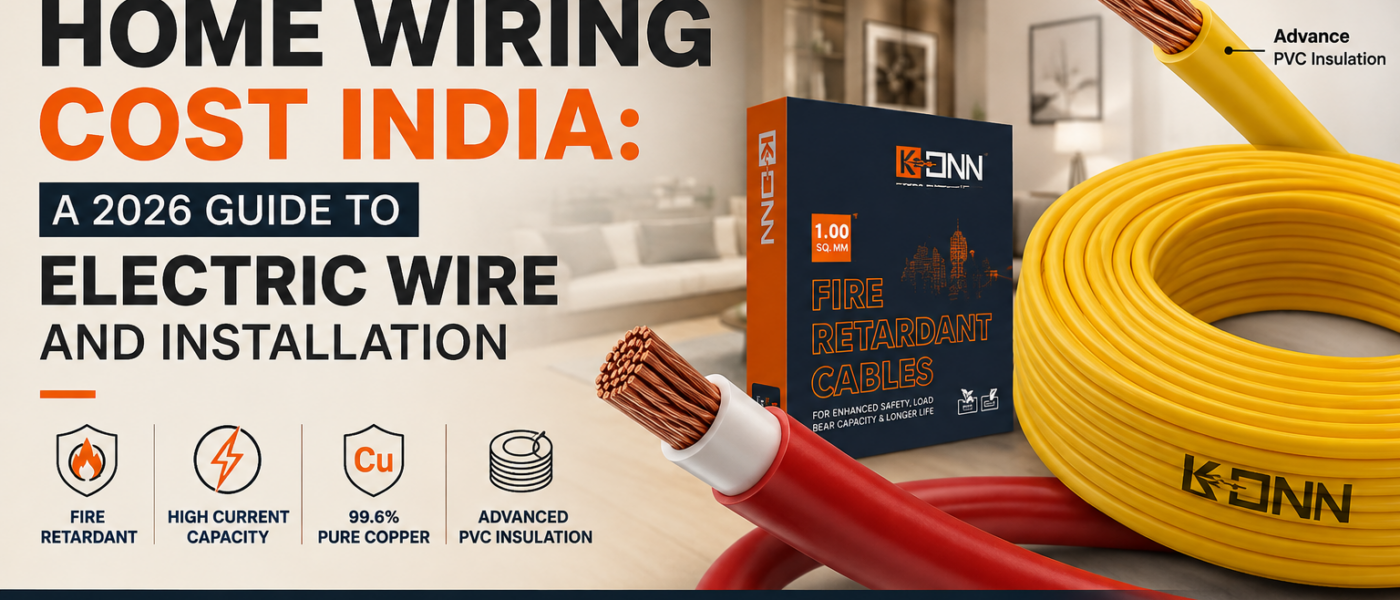
Quick Answer: Home wiring cost in India ranges from ₹25–₹75 per sq ft for labour, and ₹80–₹180 per metre for FR copper wire. A standard 2BHK costs ₹46,000–₹75,000 and a 3BHK costs ₹70,000–₹1,15,000 for complete wiring including materials and electrician charges. Planning a construction or renovation project can be a daunting task, especially when budgeting
Quick Answer: A DP (Double Pole) switch simultaneously disconnects both the live and neutral wires, providing complete electrical isolation. It is mandatory for high-load appliances like air conditioners (32A DP) and geysers (20A or 32A DP) in Indian homes, where a normal 5A switch is not safe to use. When wiring a modern house, safety
Quick Answer: For Indian homes, LED battens are best for kitchens and large areas (bright, uniform light), LED downlights for false ceilings in living rooms and bedrooms, and LED bulbs for lamps and smaller spaces. Always choose warm white (2700K–3000K) for bedrooms and cool white (4000K–6500K) for kitchens and study areas. Look for ISI certified